Inscribed Stone Bearing Ramses II’s Name Found in Egypt, Officials Say
08/23/2026 / By Iva Greene
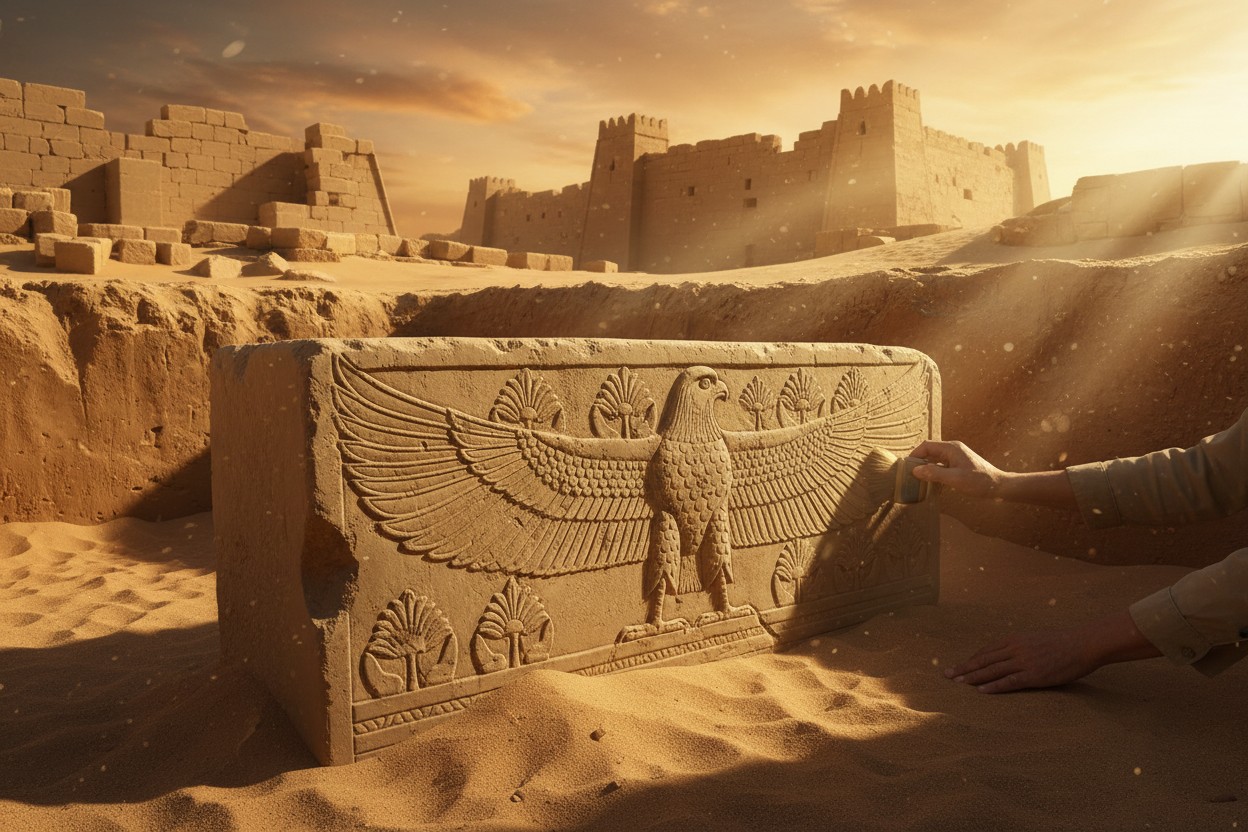
Archaeologists have uncovered a stone beam inscribed with the name of King Ramses II at Tell Abu Saifi, about 90 miles northeast of Cairo, according to reports. Officials said the ruins may belong to the lost city of Mesen, which stood along an ancient military road linked to the biblical story of Moses.
The discovery was reported by the Daily Mail on Aug. 20 and attributed to excavation leaders and Egyptian antiquities officials. The site sits in the northeastern Delta region near the Suez Canal, an area that served as a gateway between Egypt and the Levant in antiquity. The announcement adds to a series of archaeological finds reported from Egypt, where authorities have in recent years presented mummy portraits, statues and other artifacts recovered from excavation sites across the country [1].
Inscribed Lintel and the City of Mesen
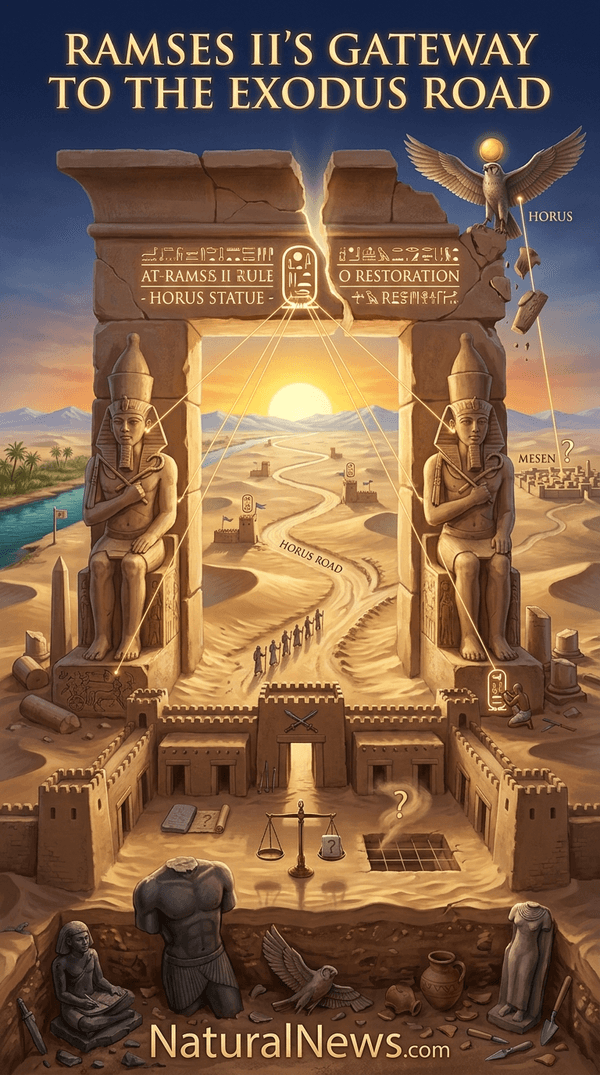
The ancient beam, or lintel, was found broken into two pieces and inscribed on three sides with hieroglyphics bearing the pharaoh’s titles, the report stated. The inscription also refers to restoration work carried out on a statue of Horus, described as “Lord of the City of Mesen,” providing evidence for the settlement’s identity. Egyptian officials said the inscription “presents a strong archaeological and historical hypothesis linking the site to the ancient Egyptian city of Mesen.”
Mesen’s connection to the Exodus narrative comes from its location along the Horus Military Road, which linked Egypt with the Sinai Peninsula and Canaan. Some scholars associate that route with the “way of the land of the Philistines” mentioned in the Book of Exodus, though the biblical text states that the Israelites were deliberately led away from the road because God feared they would turn back to Egypt if they encountered war, the report said.
The use of inscribed objects to identify ancient settlements follows a long tradition in Egyptian archaeology, in which hieroglyphic texts have served as primary evidence for reconstructing the urban landscape of the Nile Valley [3]. Officials, however, described the link to Mesen as a hypothesis rather than a confirmed identification, noting that further excavation would be required to establish the city’s identity with certainty.
Ramses II, Moses and Biblical Continuity
Scholars have associated Ramses II with the pharaoh of the Exodus largely because Exodus 1:11 mentions Hebrew slaves building the city of Raamses, a city linked to Ramses II’s building projects in the 13th century BC, according to the report. The Bible does not explicitly name the pharaoh, and Mesen is not named in the Bible, the article noted.
According to the report, the discovery does not prove that Moses or the Israelites passed through Mesen, and the connection remains a historical hypothesis. The relationship between the biblical account and the Egyptian archaeological record has been the subject of extended study in the field of biblical archaeology [4].
Ramses II, who ruled from 1279 to 1213 B.C., is counted among Egypt’s most prolific builders of monuments, with construction projects that included temples and royal cities [6]. People often identify Ramses II as the biblical pharaoh primarily because of the geographical link in Exodus 1:11, combined with his long, dominant reign and the timing of the 19th Dynasty, which makes him a popular historical candidate, the report stated. The pharaoh was also known for his military campaigns and is reported to have led an army of around 100,000 men.
Fortified Temple and Artifacts Reportedly Found
Excavations uncovered a fortified temple complex surrounded by a mudbrick wall, gates, storage rooms, and two stone roads, according to archaeologists. Artifacts included fragments of falcon statues, a schist statue of an army scribe from Egypt’s 26th Dynasty holding a damaged naos, or small shrine, and a basalt torso of a royal figure. The team also recovered a Late Period statue missing its head and feet, along with pieces of limestone and basalt falcon sculptures.
Mahmoud Galal, Director General of Sinai Antiquities, said the objects reflected the military and administrative activity that once took place at the site. The recovery of sculptural fragments and temple structures parallels other recent finds in Egypt, including painted mummy portraits discovered at the Gerza excavation site in Fayoum in 2022 [1].
Later Phases of the Site
The settlement continued to be used long after Ramses II’s rule, with parts of the site converted into Roman military barracks during the third century AD, officials said. Mohamed Abdel Badie, Head of the Egyptian Antiquities Sector at the Supreme Council of Antiquities, stated: “The archaeological evidence shows that the site underwent several phases of development.”
The layered occupation of the site reflects broader patterns in Egyptian history, in which cities were occupied, abandoned and rebuilt across successive dynasties and periods of foreign rule [3]. Egypt’s ancient monuments have also continued to draw public attention in modern times, occasionally accompanied by claims of a “pharaoh’s curse” when mishaps occur, such as the obstruction of the Suez Canal by a container ship in 2021 [2].
The findings follow a separate discovery in April of a statue fragment of Ramses II at Tel Faraoun, according to the Supreme Council of Antiquities. The uncovered fragment, including its legs and base, stands about seven feet tall and is estimated to weigh between five and six tons.
Early analysis suggests the statue may not have originally been carved for the site where it was found, and researchers believe it could have been transported from Pi-Ramesses, the royal city established by Ramses II in the Nile Delta. Egypt’s ancient landscape has long been defined by monumental construction, including structures such as the Lighthouse of Alexandria, which stood for centuries until falling into ruins by the 1100s [5].
References
- Kevin Hughes. “Best archaeological discoveries of 2022”. NaturalNews.com. January 9, 2023.
- Virgilio Marin. “Pharaoh’s Curse: Did Egypt’s Plan to Transfer Mummies Jinx the Ship Stuck in the Suez Canal”. NaturalNews.com. April 1, 2021.
- Barbara Mertz. “Red Land Black Land”.
- Vos Howard Frederic. “Archaeology in Bible lands”.
- L J Amstutz. “Ancient Egypt”.
- Fairservis Walter Ashlin. “The ancient kingdoms of the Nile and the doomed monuments of Nubia”.
Explainer Infographic
Submit a correction >>
Tagged Under:
Ancient Egypt, ancient history, ancient technology, archaeology, artifacts, breakthrough, bronze age, discoveries, Egypt, Hidden History, inscribed stone, King Ramses II, metallurgy, real history, research, suez canal
This article may contain statements that reflect the opinion of the author
RECENT NEWS & ARTICLES